Atomic Habits: Summary

No matter your goals, Atomic Habits offers a proven framework for improving every day. James Clear, one of the world's leading experts on habit formation, reveals practical strategies that will teach you exactly how to form good habits, break bad ones, and master the tiny behaviors that lead to remarkable results. If you're having trouble changing your habits, the problem isn't you. The problem is your system. Bad habits repeat themselves again and again not because you don't want to change, but because you have the wrong system for change. You do not rise to the level of your goals. You fall to the level of your systems.
Here, you'll get a proven system that can take you to new heights. Clear is known for his ability to distill complex topics into simple behaviors that can be easily applied to daily life and work. Here, he draws on the most proven ideas from biology, psychology, and neuroscience to create an easy-to-understand guide for making good habits inevitable and bad habits impossible. Along the way, readers will be inspired and entertained with true stories from Olympic gold medalists, award-winning artists, business leaders, life-saving physicians, and star comedians who have used the science of small habits to master their craft and vault to the top of their field. Learn how to: - Make time for new habits (even when life gets crazy); - Overcome a lack of motivation and willpower; Design your environment to make success easier; Get back on track when you fall off course; and much more.
Atomic Habits will reshape the way you think about progress and success, and give you the tools and strategies you need to transform your habits- whether you are a team looking to win a championship, an organization hoping to redefine an industry, or simply an individual who wishes to quit smoking, lose weight, reduce stress, or achieve any other goal.
Chapter 1: The result of small actions can be huge
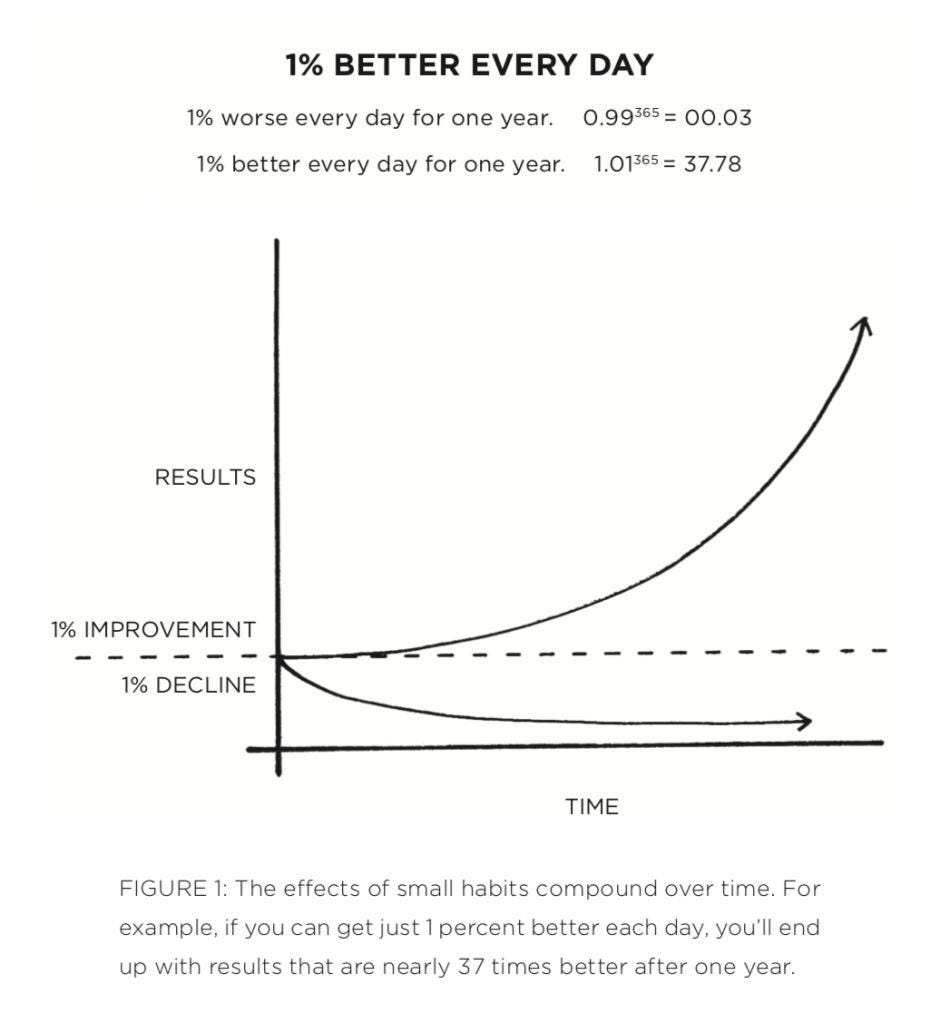
The hypothesis of improving 1% isn’t noticeable sometimes but the difference it makes over time is remarkable. When we want to change our life, we start making changes in ourselves but the small changes don’t seem to matter very much at the moment. Still, if we focus completely on what changes we want to acquire and on the system of change, we can easily see the difference over the years. Choosing for ourselves, be it a small change at the very moment, will determine the difference between who we are and who we could be.
In life, there are two kinds of people:
Successful people
Unsuccessful people
Let’s say if both successful and unsuccessful people share the same goals, then what makes the difference between them? Goals? It isn’t about the goals that make the difference between them. Goals have always been there, no matter what you do, because you don’t start doing something without knowing how it will end, and what your outcome will be. But only having a goal is not enough, because it’s about the process, it’s about how you implement it in your life. Everybody shares the same goals but only the people who implement a system of continuous small improvements achieve an outcome.
What’s the difference between goals and systems? Goals are about the results you want to achieve. If you’re a coach, your goal might be to win a championship. But systems, it is a process that leads to those results. As a coach, your system is the way you recruit players, manage your assistant coaches and conduct practice. So, we mistakenly assume that having an ambitious goal leads to success while overlooking all of the people who had the same objective but didn’t succeed in life. If you spend time designing your systems, it will lead to a successful outcome. You will attain your desired goal.
We can conclude from this: “ If you want better results, then we should forget about setting goals, goals come next. We should focus on our systems first which is the process of attaining the desired goal.”
"However, prioritizing goals over systems can lead to several issues."
1. Achieving a goal is only a momentary change.
"You might question, would you still succeed if you solely focused on your goals and neglected your system?". Let’s say, if you were a basketball coach, your goal is to win a championship and you did not focus on what your team does at practice, would you win? Not. The goal in any sport is to finish with the best score, but it would be ridiculous to spend the whole game staring at the scoreboard. The only way to win is to get better each day. The system helps you make progress.
Achieving a goal is a momentary change. Once our goal is achieved there’s not much to do. So focusing on our systems is the utmost priority.
For instance, imagine you are a lazy person, and you set your goal of being productive your entire life. If you summon the energy to be productive, then you will have a productive day- for now. But if you maintain the same pack-rat habits that led to being a lazy person in the first place, soon you’ll be a lazy person hoping for another burst of motivation. You’re left chasing the same lazy person as an outcome because you never changed your system behind it. When you solve problems at the results level, you only solve them temporarily, to improve you need to solve problems at the systems level.
2. Goals restrict your happiness.
We all make assumptions before reaching our goal. This is the entire problem with us. We are putting our happiness off until we reach our goal. Completely having a mindset of “ Once I reach my goal, I’ll be happy”, creates an “either-or” conflict. Either we achieve our goal and are happy or we fail and it leads to a huge disappointment. We mentally picture ourselves as a narrow version of being happy. This makes no sense for us to restrict our happiness to what our desired goals are. Because sometimes we achieve and sometimes we don’t.
Let’s say. I’m a student and my goal is to score 95% marks. I worked hard, be it day and night. I spent all my time studying and gave my best. Solved all the questions that I needed to, and read all the important notes. I was fully prepared. I gave my 100% effort, and when the result came, it wasn’t 95% it was unfortunately 85%. My goal was to achieve 95% but I scored 85% which made me feel disappointed in myself. But what if I saw the system, the process of how hard I worked to achieve my goal, what if I loved the efforts that I put into it, and be happy? It would have been great. When you fall in love with the process, you don’t have to wait to permit yourself to be happy. You can be satisfied when your system is running.
Even if you don’t achieve your desired goal, you can still be happy with the process you carried on. Restricting happiness until our goals are achieved is completely the wrong thing. It’s misguided. It is unlikely that your actual path through life will match the exact journey you had in mind when you set out.
3. Goals are at odds with long-term progress.
If you have a messy room, and you set a goal to clean it. If you summon up the energy to tidy up, you will have a clean room. But after a few days, if you still maintain the same sloppy habits that led to a messy room, you will need to have motivation again. When all of your hard work is focused on a particular goal, what is left to push you after you achieve it? This is why people find themselves reverting to their old habits after achieving the desired goal.
The purpose of setting goals is to clean the room. The purpose of building systems is to continue cleaning the room. True long-term thinking is goalless thinking.
It’s not about accomplishing a single goal, it’s about the cycle of endless improvement which determines the progress.
The compounding effects of atomic habits.
As you all know, habits are the compound interest of self-improvement. In a very similar way how money multiplies through compound interest, the effects of habits multiply as we repeat them.
If you invest a tiny portion of your income every month in a few years ( all things being equal), you will reap massive gains. In a decade, you could be on a path toward personal financial freedom. You could also accumulate enough for your emergency fund.
If you accept that time is required for any small change to reach a productive point, you will be able to see the compound effect and have formed a lasting positive habit that can lead to more improvement and happiness in the future.
Habits are a double-edged sword; bad habits can cut you down just as easily as good habits can build you up, which is why understanding how your habits can compound for you or against you is crucial.
Let’s distinguish how habits can compound for you:
Positive habits
Productivity compounds: Accomplishing one small habit daily won’t be noticeable but it counts for a lot over an entire year. The effect of mastering a new skill can be even greater.
Deciding to wake up at 5 a.m. and do some exercises might be a small change at the very moment, but when you look over the years you’ll find out how this habit led to a big change which helped you stay healthy and keep your body healthy.
Knowledge compounds: Learning one skill won’t make you a genius, but a commitment to lifelong learning can be transformative. When you learn a skill, you not only learn something but also open up to different ways of thinking.
If you read a book once a month, you’ll find it knowledgeable and then forget about it, you won’t change your life, but if you read a page daily, you'll learn a lot and at a slow pace you can make an impact on your life. You can make changes to your life.
Relationships compound: The way we behave and act with people, reflects our behavior. The more kind we are, the more people will be kind to us. The more good we are to people the more we will attract people towards us. Treating people in a good way will help us build a good relationship.
If you decide to treat people in a friendly way, friendlier you’ll become. You attract how you are treated.
Negative habits
Stress compounds: Being stressed these days is way too common, and it may occur now and then, but when the common causes of stress persist for a long time, this may result in serious health issues.
If you are stressed about making ends meet, the frustration of a traffic jam, the weight of parenting responsibilities, or the strain of high blood pressure, there are some common causes of stress but if they last for a long time, this may be harmful to your mental and physical health which may lead to some consequences.
Negative thoughts compound : The more you think of yourself as worthless, and stupid, the more you condition yourself to interpret life that way. You get trapped in a thought loop. Having such thoughts sometimes is normal, but completely dissolving yourself in those thoughts and picturing yourself as worthless or stupid will make your self-esteem low. This may have a huge effect on mental health.
If you think people in this world are selfish, unjust, and worse you’ll end up seeing those kinds of people everywhere which will make you avoid people and hate them and you’ll start distancing yourself from people around you. These kinds of thoughts affect me a lot. Whatever you think reflects what kind of thoughts you hold up in your mind.
Outrage compounds : Riots, protests, and mass movements are rarely the result of a single event. Aggressiveness daily slowly multiplies aggression and it spreads like wildfire.
If someone throws hateful comments at you, and you hold up the comment in your mind, think about it all day, it would lead to aggression and slowly you’ll end up being aggressive and it will affect your mental health.
All big things come from small beginnings. The seed of every habit is a single, tiny decision. But as that decision is repeated, a habit sprouts and grows stronger. People make a few small changes but fail to see a tangible result and decide to stop. For instance, I’ve been eating healthy food every day for a month, so why can’t I see any change in my body? Once this kind of thinking takes over, it’s easy to let go of good habits fall by the wayside. But to make a meaningful difference, habits need to persist long enough to break through this plateau, which is called a plateau of latent potential. Mastery requires patience. Success is not a goal to reach or a finish line to cross. It is a system to improve, an endless process to refine. The secret to getting results that last is to never stop making improvements. It’s remarkable what you can build if you just don’t stop. Small habits don’t add up, they compound.
Chapter 2: We do those things over and over again from which we get some reward.
Have you ever considered what it’s like to change your identity? And no I’m not talking about becoming a spy or pretending to be someone else. But rather changing the beliefs we have about ourselves. Whether we’re conscious of it or not, we associate ourselves with certain identities, whether it’s good or bad. For example, you can say you’re a good cook. Or you have a great ear for music. Or you’re the handyman type. But then again, you can also consider yourself to be “bad at math”, “terrible at remembering names”, or “awful at finding directions”. What’s interesting is, the identities that we associate with ourselves influence whether we succeed at forming a new habit.
Why is it so easy to repeat bad habits and so hard to form new ones? It is a cruel and likely fact at the same time next year you’ll be doing the same thing and not something better. Changing our habits is challenging for two reasons :
We try to change the wrong thing.
We try to change our habits in the wrong way.
There are three layers at which a change can occur: The book suggests three levels of change. And it's much like peeling an onion. The first level is trying to change our outcomes. The second is changing our processes, while the third deals with changing our identity.
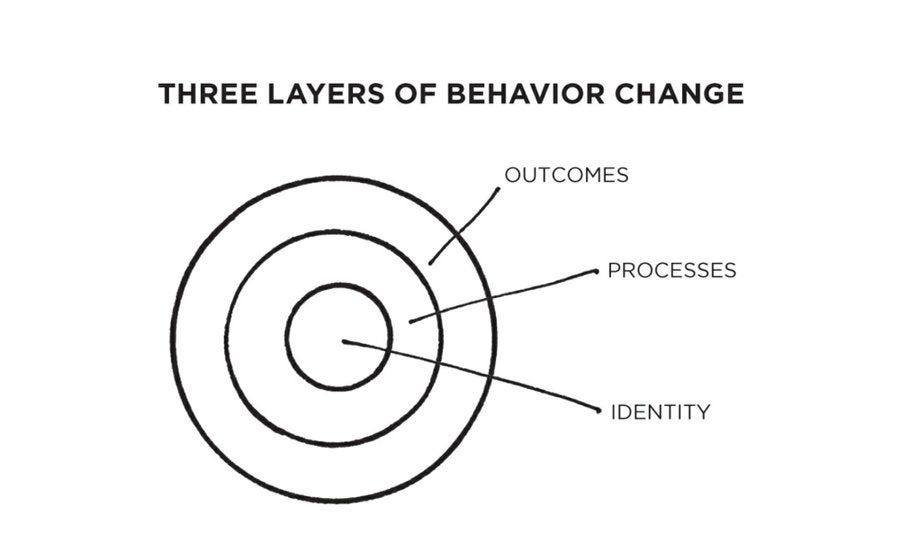
Changing your outcomes: Losing weight, winning a championship, writing a book.
Changing your process: Changing your habits and systems and developing new routines.
Changing your identity: Changing your beliefs, your worldview, your self-image, and your judgment about yourself and others.
Most of the habits you build are at the process level. Outcomes are about what you get. Processes are about what you do. Identity is about what you believe.
When it comes to building lasting habits, many people start their process by focusing on what they want to achieve. This leads to outcome-based habits. Alternative methods are to build identity-based habits. This approach allows us to shift our focus from the tasks we want to do to become the person who is most likely to accomplish those tasks. With this approach, we focus on what we wish to become. It is much more powerful to be a non-smoker than to quit smoking. When you’re a non-smoker, by your identity you do not smoke. When you (try to) quit smoking, it implies you’re still a smoker.
Most people don’t even think about changing their identity when they think about changing their habits. They just think they want to be skinny (outcome). They think if they stick to a diet, they’ll be skinny (process) but they don’t realize their old identity can sabotage their new plans for change.
Behind every system of actions is a system of beliefs. Behavior that is incongruent with the self will not last. It’s hard to change your habits if you don’t change the underlying beliefs that led to your old habits. You have a new goal and you have a new plan but you haven’t changed who you are. The ultimate form of intrinsic motivation is when the habit becomes a part of your identity. It’s one thing to say you’re the person who wants this, and it’s something very different to say you’re the kind of person who is this.
The more pride you have in a particular aspect of your identity, the more motivated you’ll be to maintain the habits associated with it. True behavior change is identity change. You might start a habit because of motivation but the only way you’ll stick to it is if it becomes a part of your identity. Improvements are only temporary until they become a part of who you are. The goal is not to read a book, the goal is to become a reader.
Your behavior is usually a reflection of your identity: If you've watched the recent movie release, Mulan, you can probably relate it to the scene where the witch tells her that her deception weakens her. In a way, when we identify ourselves in a certain way, and our actions oppose our identity beliefs, we end up slipping back to old habits that are more congruent with how we identify ourselves. "Your behaviors are usually a reflection of your identity.” What you do is an indication of the type of person you believe you are. Doing is easy when behavior and identity are aligned. You’re already acting like the type of person you want to be.
When you have repeated a story to yourself for years, it is easy to believe in it. You begin to resist certain actions because you think that’s who you are. The more deeply a thought is tied to your identity, the more difficult it is to change.
You can’t get too attached to your self-image. Progress requires unlearning. Becoming the best version of yourself requires you to continually change your beliefs and upgrade and expand your identity.
Every small action is a vote of confidence in your identity.
If your beliefs and worldview play an important role in your behavior, where do they come from in the first place? How exactly is your identity formed? Your identity emerges out of your habits. You're not born with preset beliefs. Every belief is learned and conditioned through experience. Your habits are how you embody your identity. The more you repeat a behavior, the more you reinforce the identity associated with it. The more evidence you have for a belief, the more strongly you will believe in it.
So how then can we begin to change our identity? The big relief is that it only takes small, consistent actions to get us to where we want to be. It reminds me of a concept in the book Awaken the Giant by Tony Robbins.
Imagine a table with only one leg. That table is most likely very unstable. With the slightest shake, that table is going to topple and fall. But when you add more legs to the table, it becomes stable, and likely to stand on its own. When we assume an identity and perform actions that support it, we add "legs" to this new identity, and we become more convinced that we are indeed that person. "New identities require new evidence. It's a simple two-step process.
1. Decide the type of person you want to be.
2. Prove it to yourself with small wins."
Work backward from the results you want to the type of person who would get those results.
Instead of writing a book (goal), think of being a consistent, reliable person (identity). Habits and identity form a feedback loop. Your habits shape your identity and then your identity shapes your habits. The goal should always be becoming a type of person, not getting a particular result.
The real reason why habits matter is because you have the power to change your beliefs about yourself. Your identity is not set in stone. It is you who’s got a choice in every fleeting moment. You can decide on what type of person you wish to become with the habits you chose today. Habits are not about achieving external measures like earning more money or becoming a millionaire, yes maybe your habits can help you achieve these things fundamentally but it is not about having something, it is about becoming someone. This is why habits matter because habits help you become who you wish to be. In other words, you can say “You become your habits”.
Chapter 3: How to build better habits.
Behavior followed by satisfying consequences tends to be repeated, and those that are less pleasant are less likely to be repeated.
Why does your brain build habits? A habit is a behavior that has been repeated enough times to become automatic. The process of habit formation begins with trial and error.
Try. Fail. Learn. Try differently.
With practice, the useless movements fade away and the useful actions get reinforced. Habits are reliable solutions to recurring problems that occur in our environment. As habits are created, the level of activity in the brain decreases. You lock in the cues that predict success and tune out everything else.
When a similar situation arises in the future, you know exactly what to look for. Your brain skips the process of trial and error, and creates a mental rule: "If this, then that." These cognitive scripts can be followed whenever the situation is appropriate.
Habits are mental shortcuts learned from experience. In essence, a habit is just a memory of steps you followed to solve a problem in the past.
Habits do not restrict freedom - they create it. The people who don't have their habits handled are often the ones with the least amount of freedom. Building habits in the present allows you to do more of what you want in the future. The process of building a habit can be broken down into four simple steps: cue, craving, response, and reward. The brain runs through these steps in order every time.
The cue triggers the brain to initiate a behavior. It is a bit of information that predicts a reward, something that catches your attention. Our prehistoric ancestors paid attention to cues that signaled primary rewards like food, water, and sex. Today we spend most of our time learning cues that predict secondary rewards like money and fame, power and status, praise and approval, love and friendship, or a sense of personal satisfaction. These also indirectly improve our odds of survival and reproduction, which is the deeper motivation behind what we do. Because the cue is the first indication that we are close to a reward, it naturally leads to craving.
Cravings are the second step and they are the motivational force behind every habit. Without some level of motivation and desire, some craving for change, we have no reason to act. What you crave is not the habit itself but the state it delivers. You do not crave smoking a cigarette, you crave the feeling of relief it provides. Every craving is linked to a desire to change your inner state. Cues are meaningless until they are interpreted.
The third step is response. The response is the actual habit you perform, which can take the form of a thought or an action. Whether a response occurs, depends on how motivated you are and how much friction is associated with the behavior. If it requires more effort than you're willing to put in, you won't do it. Your response also depends on your ability. A habit can only occur if you're able to do it.
The response delivers a reward. Rewards are the end goal of every habit. The cue is about noticing the reward, the craving is about wanting the reward, and the response is about obtaining the reward. We chase rewards because they serve two purposes:
They satisfy us, and
They teach us.
The first purpose of rewards is to satisfy your craving. At least for a moment, rewards deliver contentment and relief from craving. Second, rewards teach which actions are worth remembering in the future. Your brain is a reward detector. Your sensory system is constantly monitoring which actions satisfy your desires and deliver pleasure.
Rewards close the feedback loop and complete a habit. If a behavior is insufficient in any of these four stages it will not become a habit. Eliminate the cue and your habit will never start. Reduce the craving and you won't experience enough motivation to act. Make the behavior difficult and you won't be able to do it.
If the reward fails to satisfy your desire, you have no reason to do it again in the future. Without the first three steps, a behavior will not occur. Without all four, a behavior will not be repeated. This cycle is a habit loop.
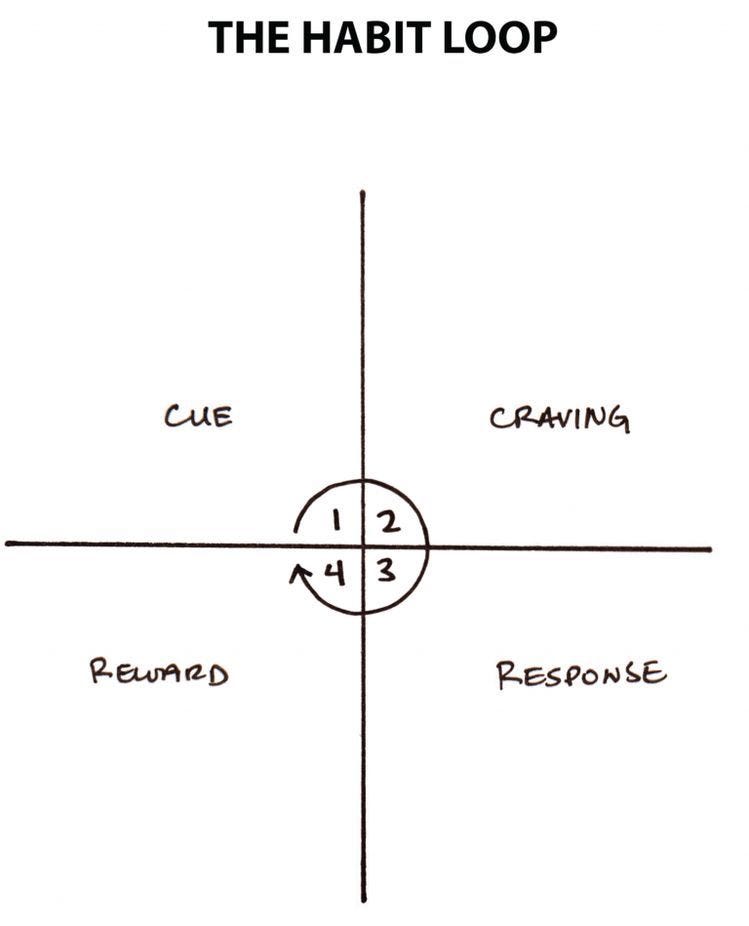
In summary, the cue triggers a craving, which motivates a response, which provides a reward, which satisfies that craving and ultimately becomes associated with the cue. Together these four form a neurological feedback loop: cue, craving, response, and reward. This process ultimately allows you to form automatic habits.
We can split these four steps into two phases: the problem phase and the solution phase. The problem phase includes the cue and the craving - it is when you realize something needs to change. The solution phase includes the response and the reward - it is when you take action and achieve the outcome you desire.
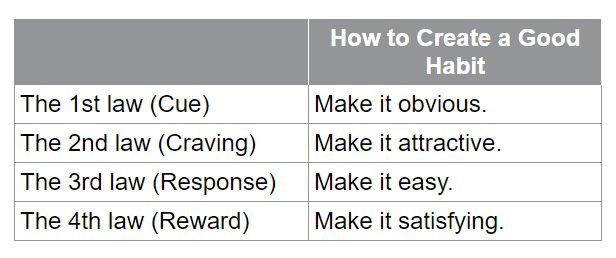
All behavior is driven by a desire to solve a problem. The four laws of behavior change provide a simple set of rules for creating good habits.
1. Make it obvious. (cue)
2. Make it attractive. (craving)
3. Make it easy. (response)
4. Make it satisfying. (reward)
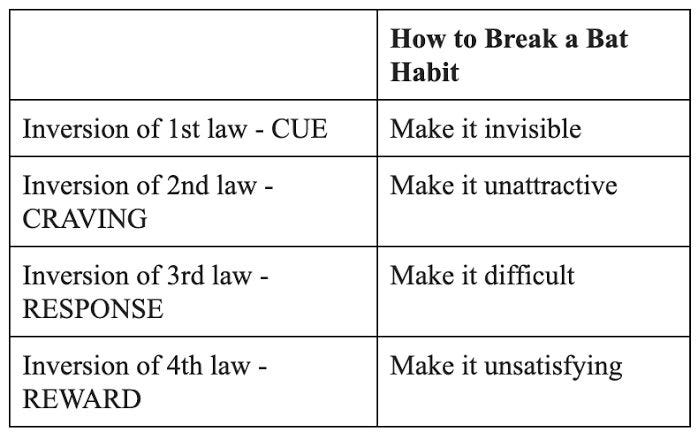
Invert these laws to break a bad habit.
1. Make it invisible. (cue)
2. Make it unattractive. (craving)
3. Make it difficult. (response)
4. Make it unsatisfying. (reward)
The key to creating good habits and breaking bad ones is to understand these fundamental laws and how to alter them to your specifications. Every goal is doomed to fail if it goes against the grain of human nature. A habit is a behavior that has been repeated enough times to be automatic. The ultimate purpose of habits is to solve life’s problems with as little energy and effort as possible.
Chapter 4: The man who didn’t look right.
The 1st law is to make it obvious.
The chapter title was coined from the story of a lady who saw her father-in-law and noticed he did not look too good. Although he claimed to be fine, she was not convinced and insisted he go to the hospital. He was taken for a series of tests and it was discovered that he was at immediate risk of heart attack. She had worked many years with people with heart failure and she unknowingly developed the ability to recognize this pattern on sight.
The human brain is a prediction machine. It is continually taking signals and analyzing what comes across. Whenever you experience something repeatedly, your brain begins noticing what is important and sorting through the details and highlighting the relevant cues, and cataloging that information for future use. With enough practice, you can pick up on the cues that produce certain outcomes without consciously thinking about them. Automatically, your brain decodes the lessons learned through experience.
Your ability to notice the relevant cues in any given situation is the foundation for every habit you have. We underestimate how much our brains and bodies can do without thinking. Most of your body functions on autopilot.
You don't need to be aware of the cue for a habit to begin. You can notice an opportunity and take action without dedicating conscious attention to it. This is what makes a habit useful but it also makes it dangerous.
Over time, the cues can become so common that they are essentially invisible. The cues are so deeply encoded that it may appear as if the action comes out of nowhere. For this reason, we must begin the process of behavior change with awareness. Before we can effectively build new habits, we need to get a handle on our existing ones. Once the habit is firmly rooted in your life, it is mostly automatic and unconscious. If a habit remains mindless, you can't expect to improve it. Until you change the unconscious to conscious, it'll direct your life and you'll call it fate.
The more automatic a habit becomes, the less likely we are to think about it. When we've done something 1,000 times over, we start to overlook things. We are so used to doing what we've always done that we don't even think to stop to question if it is the right thing to do.
There aren't really good habits or bad habits. There are only effective habits. All habits serve you in some way, even the bad ones, which is why you repeat them.
Ask yourself: "Does this behavior help me become the type of person I want to be? Does this habit cast a vote for or against my desired identity?"
The first step to changing bad habits is to be on the lookout for them. You can try pointing and calling. Say out loud the action you're going to take and what the outcome will be. For example: "I am about to eat this cookie but eating it will hurt my diet and not make me feel good." Hearing your bad habits spoken out loud makes the consequences feel more real. The process of behavior starts with awareness.
Chapter 5: The best way to start a new habit.
People who make a specific plan on how and when to perform a new habit are more likely to follow through. Too many people have tried to change their habits without having these basic details figured out. We say "I’m gonna eat healthier" or "'I’m gonna write more" but we never say when and where these actions are going to happen.
Implementation intention transforms these vague ideas into actual concrete plans. Many people think they lack motivation but what they lack is clarity. Once the objective is clear, you don't have to wait for inspiration to strike. When the moment of action occurs, there is no need to make a decision, simply follow your determined plan.
Use specific, actionable plans like "I will do x at time y in location z."
If you are unsure when to start your habit, try the first day of the week, month, or year. People are more likely to take action at those times because hope is higher. Being specific about what you want and how you will achieve it will help you say no to things that can derail your progress, distract your attention, and pull you off course.
No behavior happens in isolation. Each action becomes a cue that triggers the next behavior.
When it comes to building a habit, you can use the connectedness of behavior to your advantage. One of the best ways to build a new habit is to identify an already existing habit and then stack your new behavior on top. This is called habit stacking.
Habit stacking is a special form of implementation intention. Rather than pairing your new habit with a particular time or location, you pair it with a current habit.
"Before or after my current habit, I will make a new habit."
The key is to tie your new desired behavior to something you already do each day. Once you have mastered this, you can start chaining your habits to create longer stacks.
The secret to creating a successful habit stack is to select the right cue to kick off the behavior. Habit stacking works best when the cue is highly specific and immediately actionable. Many people select cues that are too vague. Habits like "read more" or "eat better" are worthy causes but do not provide instructions on how and when to act. Be specific and clear! The tighter a habit is tied to a cue, the more likely it is that you'll do it when it's time to act.
Create an obvious plan on when and where to take action.
Chapter 6: Motivation is overrated; the Environment often matters more.
People often choose products not because of what they are but because of where they are. If you go to the kitchen and see cookies on the table, you might pick a handful of them and eat them even if you didn’t have a craving for them or weren’t necessarily even hungry. Your habits change depending on the room you’re in and the cue that is in front of you.
The environment is the invisible hand that shapes human behavior. Despite our personalities, certain behaviors tend to rise again and again under certain environmental conditions. In libraries, people tend to stay quiet or talk in whispers. In dark alleys, people tend to be wary. In this way, the most common way of change is not internal but external. We are changed by the world around us. Every habit is context-dependent.
Behavior is a function of the person and their environment – such as impulse buying, which is triggered when a shopper sees a product for the first time and visualizes a need for it. In other words, customers will occasionally buy products not because they want them but because of how they are presented to them. For example, items at eye level tend to be purchased more than items near the floor. For this reason, you’ll find expensive brand names seated in easy-to-reach locations on store shelves because they bring in the most profit while cheaper products are hidden in harder-to-get spots. The more available a product is, the more likely you are to buy it. Many actions we take every day are not driven by purposeful choice or decision but by the most obvious option.
The most powerful of the human sensory abilities is vision. Therefore, it should come as no surprise that visual cues are the catalyst of our behavior. For this reason, a small change in what you see can lead to a big shift in what you do. As a result, you can imagine how important it is to live and work in an environment that is filled with productive cues and devoid of unproductive ones.
How to design your environment for success? Every habit is initiated by a cue and we are more likely to notice cues that stand out. Unfortunately, the environments we live in make it easy to not notice these cues. It’s easy to not play the guitar when it is tucked away in the closet. It is easy to not read a book when the bookshelf is in a corner in the guest room. When the cues that spark an action are subtle and hidden, it is easy to ignore them. By comparison, creating clear cues can draw your attention toward desired habits. For example, if you want to practice playing the guitar more frequently, place the guitar stand in the middle of the room. If you want to drink more water, fill up a few water bottles in the morning and place them in common places around the house or the office.
The context is the cue. The cues that trigger a habit can start very specific but over time your habits become associated with not a single trigger but the entire context surrounding the behavior. For example, many people drink more in social situations than they would ever drink alone. The trigger is rarely a single cue but rather the whole situation.
We mentally assign our habits to the locations where they occur. Each location develops a connection to certain habits and routines. Different people can have different habits related to the same space. For example, one person could connect the couch to reading a book and another person could associate it with watching TV. Stop thinking of your environment as filled with objects and start thinking about it as filled with relationships. You can train yourself to link a particular habit with a particular context.
The power of context also reveals an important strategy. Habits can be easier to change in a new environment. It is easier to associate a new habit with a new context than to build a new habit in the face of competing cues. It is going to be hard to study and not get distracted in the living room if that is where you play video games.
When you step outside of your normal environment, you leave your habitual biases behind. If you are trying to eat healthier, try a new grocery store. You may find it easier to avoid unhealthy foods when your brain doesn’t automatically know where you can find them in the store.
When you can’t get into a completely new environment, redefine or rearrange your current environment. Create a separate space for work, study, exercise, entertainment, or cooking. One space, one use. Whenever possible, try to avoid mixing the context of one habit with another. When you start mixing contexts, you start mixing habits.
If your space is limited, divide it into activity zones. A chair for reading, a desk for writing, a table for eating. You can also do the same with your digital spaces. Every habit should have a home. Habits thrive under predictable circumstances. A stable environment where everything has a place and a purpose is an environment where habits can easily form.
Chapter 7: The Secret to self - control
Research showed that when soldiers, who had been heroin users, returned home only 5% became re-addicted within one year and just 12% relapsed within three years. In other words, approximately 9 out of 10 soldiers, who used heroin in Vietnam, eliminated their addiction nearly overnight. This contradicted the prevailing view at the time, which considered heroin addiction to be a permanent and irreversible condition. Instead, the research revealed that addiction could spontaneously dissolve if there was a radical change in the environment.
In Vietnam, soldiers spent all day in environments triggering heroin use. It was easy to access, they were engulfed by the distress of war, they built friendships with fellow soldiers who were also heroin users, and they were far away from home. Once the soldiers returned to the United States, they found themselves void of those triggers. When the context changed, so did the habit.
If you’re overweight, a smoker, or an addict, you may have been told your entire life it is because you lack self-control – maybe even because you’re a bad person. The idea that a little bit of discipline would solve all of our problems is deeply embedded in our culture.
However, recent research shows something different. When scientists analyze people who appear to have tremendous self-control, it turns out those individuals aren’t all that different from those who are struggling. Instead, disciplined people are better at structuring their lives in a way that does not require heroic willpower and self-control. In other words, they simply spend less time in tempting situations.
The people with the best self-control are typically the ones who need to use it the least. It’s easier to practice self-restraint when you don’t have to use it very often. Perseverance, grit, and willpower are essential to success but the way to improve these qualities is not by wishing you were a more disciplined person but by creating a more disciplined environment.
This counterintuitive idea makes even more sense when you understand what happens when a habit is formed in the brain.
A habit that is encoded in the mind is ready to be used whenever a relevant situation arises. Once a habit has been encoded, the urge to act follows whenever the environmental cues reappear.
This is also one reason behavior change techniques can backfire. Shaming obese people with weight loss struggles can make them feel stressed. As a result, they can return to their favorite coping mechanism, which is overeating. If you’re not careful about cues, you can cause the very behavior you want to stop.
You can break a bad habit but you’re unlikely to forget it. Once the mental map has been carved into your brain, it is nearly impossible to remove it entirely, even if it goes unused for a while. Therefore, simply resisting temptation is an ineffective strategy.
In the short run, you can overpower temptation. In the long run, you become a product of the environment you live in.
To put it bluntly, no one has ever stuck to positive habits consistently in a negative environment. A more reliable method is to cut the bad habits at the source.
One of the most practical ways to eliminate a bad habit is to reduce exposure to the cue that causes it. If you can’t seem to get any work done, leave your phone in another room for a few hours. If you’re continually feeling like you’re not enough, stop following social media accounts that trigger jealousy and envy. If you’re playing too many video games, unplug the console and put it in the closet after each use.
This practice is an inversion of the first law of behavior change. Rather than make it obvious, make it invisible. This simple change can be very effective. Remove a single cue and the entire habit often fades away.
Self-control is a short-term strategy. You may be able to resist temptation once or twice but it’s unlikely you can muster the willpower to override your desires every time. Instead of summoning will every time to avoid a bad habit, your energy would be better spent on optimizing your environment.
This is the secret of self-control. Make the cues of your good habits obvious and the cues of your bad habits invisible.
Chapter 8: How to make a habit irresistible
The 2nd Law of Behavior change is to make it attractive.
The attractiveness of an event correlates with the likelihood that it will become a habit. However, first, we must understand our cravings, which occur by measuring changes in dopamine levels.
Dopamine is a key player in the habit-creation process. It's how the brain rewards good behavior. The most addictive habits are the habits that also dump the most dopamine into your system. The crazy thing is that, once the habit is formed you don't get dopamine for completing the desired task. You get dopamine in anticipation of it. An addict gets the dopamine bump from seeing the drug, not from doing it. That bump is the craving.
It's not just dopamine. There are other neurotransmitters at play. But
"Dopamine" is easier to say/type than"dopamine, a slew of other neurotransmitters, and multiple biological processes in the brain".
It doesn't change the implications or applications.
It quietly paints the picture that your brain is an addict hooked on dope. Oddly enough, that's completely true but it's also the dealer. The brain is weird.
Liking isn't wanting: We often design habits around how we'd like to act. We paint a picture of perfection. It's something we'd like to be. But we don't desire that life. Or we desire something else more. Scientists were experimenting on rats in a study of dopamine. In phase 1, they completely turned off all dopamine. They could tell that the rats still liked sugar water. (Who doesn't like an ice-cold Coke on a hot day, right?) But they wouldn't get up to get it themselves. They wouldn't get up and get anything. The rats died of dehydration.
No dopamine = no desire = no anything.
Initially, you get dopamine when you do "the act" - whatever the brain wants you to do more of. It's chemically patting you on your head and calling you a good boy. But soon (the book doesn't say how soon), the brain switches from rewarding the action to actively encouraging it. The brain gives you dopamine as soon as it gets the cue. So why don't we just stop there? We have dopamine and we haven't done anything bad. Win-win, right? No, the brain is a drug dealer. And if you "break the deal", it's going to get what it's owed. Your brain will punish you. I hope that's ludicrous enough to make you remember it. But, despite sounding crazy, that's how it plays out.
• At first, actions are rewarded with dopamine. (Action then reward)
• Then, dopamine is used to trigger the action. (Cue, reward, then action)
• If you get the dopamine but don't act, the brain withholds dopamine. That's the feeling of growing craving. (Cue, reward, punishment) When you give in, the brain gives a little bump after the act to remind you what you're supposed to be doing. (Cue, reward, punishment, action, reward)
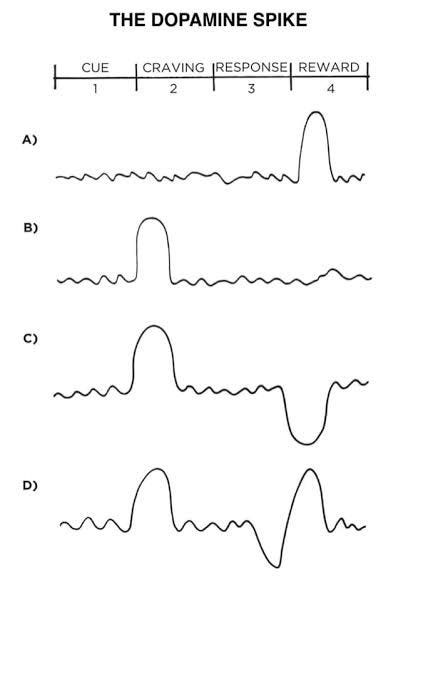
This seems challenging. I think the key is to make sure you're deciding on the habit you need between the current habit and the habit you want. I bet it's an uphill battle to try to add a habit you need in front of an existing habit you want. That would take more discipline and we know how poorly that can work. Use the big boost from the habit you want to get you to do the habit you need.
The critical piece of information is an understanding of your habits. Which is working? Which needs help? Which would you do regardless of the circumstances because you want it so much? It all goes back on track. You have to know what's going on before you can make any sensible decisions about what to do next.
Chapter 9: The role of family and friends in shaping your habits.
We learn how our family, friends, and the environment in which we grow up and mature affect and mold our habits and behaviors. Our parents are our first teachers, teaching us how to do things and teaching us things related to how they want us to live in the future. As we grow up, we tend to depend on our family and friends for certain actions we do as much as how we depend on ourselves. We imitate and adopt how they act and behave to fit in and to have a sense of belongingness. This is exemplified by how we imitate the words and speech styles of modern teens, which are popularized by the internet and social media. When one hears another using these words and phrases, they then imitate them to fit in with the crowd without even knowing it. They have adopted a new habit.
We long for a sense of belongingness and because of this we imitate and follow the script handed down to us by our friends and family, church or school, local community, and society. These cultures and groups come with their expectations and standards that guide our behavior each day. As if we are swept along by the different customs and practices of life in society - Michel de Montaigne. We imitate certain behaviors because they seem attractive to others and they help us. We imitate the habits of three groups in particular:
The close
The many
The powerful.
Imitating the Close: We pick up habits from the people around us. Our body language reflects the people we’re speaking with at that moment. Jim Rohn famously said, “You are the average of the five people you spend the most time with.” To build up better habits, join a culture where your desired behavior is normal. If you are surrounded by fit people you’re more likely to consider working out to be a common habit.
The many: Social pressure is real. Social proof is a key marketing tool. That’s why reviews and testimonials are so powerful. When in doubt, we default to whatever the group thinks. And when we’re not in doubt, the group’s beliefs can still override the individual’s beliefs and conclusions. It’s scary. The book cites a study from the 1950s. A group is presented with an easy-to-solve problem. The answer is obvious. The trick is that only 1 person is being evaluated. The rest of the group is going to deliberately give the same wrong answer. What happens? About 75% of the individuals cave in and change their answer from the correct answer to the group’s incorrect answer. And the larger the group, the more powerful the group-think.
The powerful: We copy the habits of the powerful and avoid the habits that make us look like less desirable members of society. Attractive behaviors are the behaviors that “get us approval, respect, and praise.” Yes, we don’t want to look like “the slob of the neighborhood”. That’s a power positioning issue. But other examples are based on favorites. “You make a recipe from your favorite baker. You borrow the storytelling strategies of your favorite writer.” Being somebody’s favorite doesn’t make them powerful or popular with the group. They’re not necessarily “high-status people”.
Maybe this should have been a 4th group. If you like something or someone you give them more attention. More attention = more influence? More impact? And if they’re your favorite, you probably trust them. What exactly is the role of trust in this? Or does this belong in this section because we want approval from our favorites even if only subconsciously? These are double-edged swords. Peer pressure can make us do the wrong thing. But a group with the traits, habits, beliefs, and norms that we desire can make those things easier to develop in ourselves. Copying a successful person’s habits could help us be more successful. But we could be copying something irrelevant. Or we only absorb the visible aspects of a habit and incorrectly implement the habit rendering it ineffective or useless.
Chapter 10: How to find and fix the causes of your bad habits
This chapter addresses cravings, their source, and how to reduce their control over you. A craving is just a specific manifestation of a deeper underlying motive.
You have a craving because you need something or you think you need something based on experience. It’s your brain saying, “Normally when I think of not doing something wrong my brain answers why haven’t you done it yet? Do it already. Do it! Do it now!”
It makes brains seem like needy jerks. But they’re just trying to keep things simple. They are trying to prevent you from finding a new solution to an old problem. That’s wasted effort in most cases.
It’s all about shifting to a positive mindset. You don’t “have to”. You “get to”. James Clear’s example is a story about a man in a wheelchair. “I”m not confined to my wheelchair – I am liberated by it. If it wasn't for the wheelchair, I would have been bound in my bed for the rest of my life. This shift in perspective completely transformed how he lived each day .”
Saving money can be unpleasant in the short run. Having a goal that excites you can make the habit easier to follow.
We don’t notice all of the signals we sense because our brain deliberately shelters us from them. We’d be overwhelmed if we “manually” processed every input we received: every scent, every smell, every sound, every tactile sensation. But all of that combines into a specific pattern. Repeat that pattern enough times, you have a trigger. Done deliberately, you have the
foundation for a new habit of your choosing.
A craving is a sense of something that is missing". He talks about desire, how the emotion that allows you to mark things as good, bad, or indifferent. Emotions run so much, and if you can learn to control your emotions and replace them with good habits, you will find yourself having more success in the areas of your life that you want to have success in.
The key to finding and fixing the causes of your bad habits is to first reframe the association you have with them. It's not easy, but if you can reprogram your prediction, "I have to" but "I get to", you can transform a hard habit into an attractive one.
Chapter 11: Walk slowly, but never backward
The 3rd law makes it easy.
An experiment was conducted by Jerry Uelsmann, a professor at the University of Florida. In a class on film photography, he divided his class into two groups and gave them different assignments. One half was graded on quantity, and the other half was graded on quality. The best photographs were produced by the quantity group because they practiced more. To change, you do not need to find the best plan or strategy, you just have to start. James Clear distinguishes between being in motion and taking action. Being in motion involves planning, strategizing, and learning. However, this does not produce results. In contrast, action describes concretely working towards a goal.
Action trumps motion: James Clear uses the term motion for all the things that feel like work but aren’t. That’s the planning and researching. He admits there is a time and place for that, but there are limits. Once you’re doing it to (subconsciously) avoid failure and criticism, you’re procrastinating.“If you want to master a habit, the key is to start with repetition, not perfection.” The 3rd Law is “Make It Easy”. This is so you can get the repetition.
Motion is researching diet plans; action is starting a diet. Motion is seductive because it makes you feel like you are working towards a goal without having to try. Once you try, you might fail, and humans try to avoid failure.
21 days to form a habit?
That’s what I’ve always heard. How about you? Well, not only is 21 days wrong, it’s irrelevant. The time invested is a side effect. It’s all about the reps. Do more repetitions and develop the habit or skill quicker.
“To build a habit, you have to practice it.”
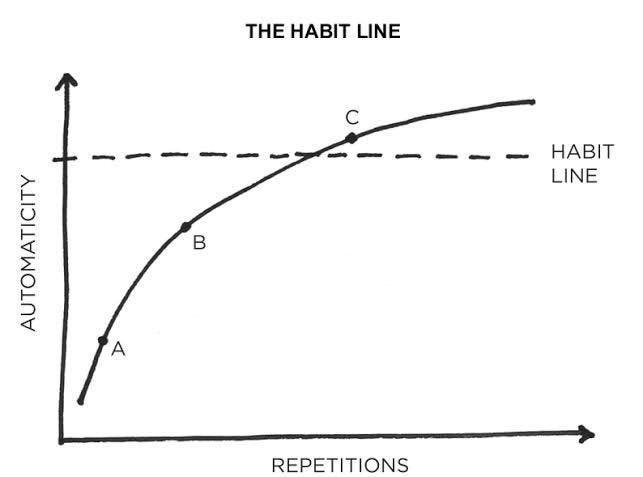
James Clear makes a critical observation about your current habits: “Your current habits have been internalized throughout hundreds if not thousands of repetitions.” Whether deliberate or not, you’ve put in the reps on your bad habits. How can you hope to dig out of that well-worn mental groove without deliberate action taken repeatedly?
Practice makes perfect. Do the work – repeatedly and poorly if necessary. Fall 7 times, get up 8. This is the grind of new habit creation. It isn’t easy to program yourself.
Chapter 12: The law of least effort
Human behavior follows the Law of Least Effort. We will naturally gravitate toward the option that requires the least amount of work.
The path of least resistance is a popular route. Habits are obstacles. I thought this an interesting idea. We want to be in shape. We want to be healthy and fit. We don’t want to get up at 5 am to run. We don’t want to eat junk food. The habit isn’t what we’re after. It’s a means to an end. So if the habit is too much, it gets skipped. The easier the habit, the more likely you are to do it. Yeah, obvious. But what have you done to make your hard habits easier? Wasting effort. Environmental design might be the best tool for forming or breaking habits
You can fight your desires or you can change your environment so that good habits are easy and bad habits are hard. If you’re craving a snack, there’s a chance you’ll grab whatever is easiest – good or bad. So make good choices and the easiest choices.
To implement this, you have to identify where you’re struggling and look at the flow of events that leads to that obstacle. From there, look for decisions or tasks that can be simplified. Better yet, find ways to remove them. Make your decisions when you have willpower and design a system that makes it easy to adhere to it when willpower is low.
Chapter 13: How to stop procrastinating by using the two-minute rule
Habits can be completed in a few seconds but continue to impact your behavior for minutes or hours afterward. It’s easier to continue what you are doing than start something different. Many habits occur at decisive moments – choices that are like a fork in the road – and either send you in the direction of a productive day or an unproductive one. It’s easy to start too big. Excitement inevitably takes over and you end up trying to do too much too soon. Habit stacks can start with anything – even almost nothing.
The 2-minute rule
There are a bunch of reasons starting a new habit is hard. The new habit is
•too big
•too scary
•too time-consuming
There is a simple tactic that counteracts all of that: Ensure that the new habit takes less than 2 minutes. It’s hard to be afraid of something that won’t take more than a few minutes. It seems silly or pointless. But it is a great way to get started. If nothing else, you’re building the habit of reacting properly to the trigger.
The power of getting a good start
Any habit can be the foundation of a habit stack. James Clear used the term “gateway habit”. Any habit, even a habit that only takes 2 minutes, can be grown into a bigger habit or used as the foundation of a habit stack.
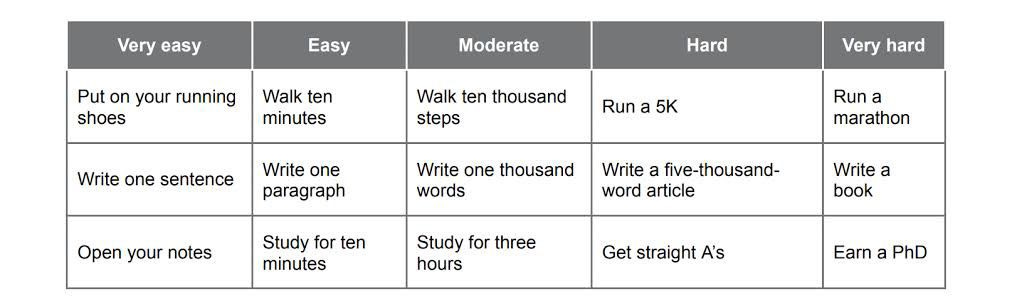
Once you’re used to sitting down with a book at the same time every day, it’s easy to go from 2 minutes of reading to 3 minutes to 5 minutes to 15 minutes. At the same time, reading could be the 1st of several habits. For example, when you put your book away, you could get out a notebook for journaling.
The earlier the decision, the more effect it has. Habits are automatic choices that influence the conscious decisions that follow. Some decisions have more impact than others. It could be the timing of the decision. It could be that it affects your mood. It could be that the decision limits the options for future decisions. Decisions (or habits) executed further “upstream” have more impact on your day.
It’s time to double down on starting the day right. I’ve been working on my morning ritual. It’s time to stop messing around and define the 1st few steps. I don’t have to know every action I want to include in the habit stack. To start, I just need to decide on the trigger and the 1st action. Then I can start putting in the repetitions.
Chapter 14: How to make good habits inevitable and bad habits impossible
James Clear discusses 2 approaches to making “good habits inevitable”: automation and one-time choices that shape the environment.
Automation
Automate what you can – especially things that are a challenge for you. This takes you out of the equation. The desire doesn’t have a chance to give your problems because it was never involved.
You can’t forget.
You can’t change your mind (at the moment).
You’re not using any willpower. You don’t even have to remember.
Onetime choices
Clear also talks about shaping your environment with one-time decisions. His examples include improving your sleep by getting a better mattress or getting your TV out of your bedroom. This is a great example because this can be done by adding something or removing something. He also mentioned blackout curtains – they’re my best one-time decision for productivity.
Make bad habits impossible. There’s dieting saying that’s a great example of this: you diet at the grocery store. When I had to lose weight, changing the way I ate didn’t work until I changed the way I shopped.
You can make some bad habits impossible. You could remove programs from your phone or computer so they don’t distract you. It’s easier to make food decisions when you aren’t hungry. It’s easier to make money decisions when you aren’t suffering
When you’re full of willpower and motivation, do as much as you can shape the environment so that you’re set up for success when things get hard. The main way to implement this is simply to look for points of friction that come up over and over. And then removing the friction. I was distracted by cars driving by my office window so I put up heavy curtains.
Chapter 15: The cardinal rule of behavior change
Consistency is key. Often, you know how to do things properly or how to improve, but the quest for improvement breaks down because you forget to implement what you know. To make things consistent, apply the 4th Law of Behavior Change: make it satisfying.
For example, a public health worker named Stephen Luby traveled to Karachi, Pakistan, which had a dense population and poor public health conditions. Washing hands is one of the most important things in public health. Luby found that people were aware of the importance of handwashing, but many people washed their hands in haphazard fashions. Luby partnered with Proctor and Gamble to distribute Safeguard soap, a premium brand. The soap was more enjoyable for people to use, and quickly, disease rates fell. Six years later, 95% of the households given the Safeguard soap became habituated to the practice. The practice was enjoyable, which made it sustainable: “Change is easy when it is enjoyable”
Pleasure signals to your brain that you should repeat tasks. you live in a delayed return environment where most actions take a long time to have the intended result. In prehistoric times, humans lived in immediate-return environments where the focus was on the present or near future.
We repeat satisfying behaviors in the future based on whether we were rewarded or punished for what we did in the past. This idea in human nature gives way to the Cardinal Rule: “What is rewarded is repeated. What is punished is avoided.” While the previous laws increase the chance of performing a habit in the present, the fourth law improves us doing so in the future. But there is an internal mismatch between the types of rewards in the following two environments:
Immediate-Return Environment: The early-human societal environment in which your actions instantly deliver clear and immediate outcomes.
Delayed-Return Environment: The modern societal environment in which your actions occur for a while before delivering the intended payoff. While our brains have not evolved much, we still prioritize immediate rewards, but our society has shifted to value delayed gratification. And so, the updated Cardinal Rule reflects this idea.
Cardinal Rule of Behavior Change: “What is immediately rewarded is repeated. What is immediately punished is avoided.” Therefore, to get your habits to stick, you need to determine how to attain some immediate success or give yourself an immediate reward.
Chapter 16: How to stick with good habits every day
One of the most satisfying feelings is the feeling of making progress. A habit tracker is a simple way to measure whether you did a habit—like marking an X on a calendar. Habit tracking is obvious, attractive, and satisfying, And it goes much deeper than that. Habit tracking makes it obvious. And it makes it evident. You don’t have to try to remember what you did or how you’re doing. You have evidence. Now you can accurately reward or chastise yourself. You can find trends and address shortcomings. That’s impossible without the proper information.
Habit tracking is attractive and satisfying. This is a habit that becomes a reward. It’s motivation on tough days. And, depending on how you do it, it can be a trigger. Don’t break the chain. Habit trackers and other visual forms of measurement can make your habits satisfying by providing clear evidence of your progress. Whenever possible, automate measurement. Limit manual tracking to your most important habits. Record each measurement immediately after the habit occurs.
The habit stacking + habit tracking formula is: “After [CURRENT HABIT], I will [TRACK MY HABIT].”
For example: After I finish each set at the gym, I will record it in my workout journal. After I put my plate in the dishwasher, I will write down what I ate. Try to keep your habit streak alive. Life will interrupt you at some point. Remind yourself of a simple rule: never miss twice. If you miss one day, try to get back on track as quickly as possible. Show up on your bad (or busy) days. Lost days hurt you more than successful days help you. Doing something – ten squats or one push-up – is huge. Don’t put up a zero. Don’t let losses eat into your compounding.
Measurement is only useful when it guides you and adds context to a larger picture, not when it consumes you. Each number is simply one piece of feedback in the overall system. Just because you can measure something doesn’t mean it’s the most important thing. Be careful what you’re tracking. Your brain likes shortcuts. It may subtly push you into doing things that make your numbers good without getting you any results. And don’t ignore things you can’t track. James Clear’s example is how losing weight makes you feel. If you only look at the numbers, you might quit if they aren’t where you want them. But if your weight loss program is making you feel great, the numbers almost don’t matter.
Consistency creates identity. Identity makes habits automatic. I’m testing a productivity system that’s similar to a “don’t break the chain” type planner. It’s only been a week and I’m happy with its effectiveness and simplicity. And I’m working on improving my life documentation. Life is complicated. Humans are designed for that kind of memorization.
Chapter 17: How an accountability partner can change everything
Pain is a great motivator. This probably isn’t new to you. People don’t like pain.
The 4th law is Make It Satisfying. Its inverse is Make It Unsatisfying. But “unsatisfying” isn’t enough. If you want to stop a habit, you have to make it hurt. The more immediate and more costly a mistake is, the faster you will learn from it. Thankfully, it doesn’t have to be physical pain. Behavior is avoided when the experience is painful or unsatisfying. Pain is an effective teacher. The more immediate the pain, the less likely the behavior.
To prevent bad habits and eliminate unhealthy behaviors, add an instant cost to the action to reduce their odds. There can’t be a gap between the action and the consequences. As soon as actions incur an immediate consequence, behavior begins to change.
Habit Contract: A verbal or written agreement in which you state your commitment to a particular habit and the punishment that will occur if you don’t follow through. Find accountability partners that sign off on the contract with you. An accountability partner can create an immediate cost to inaction. Suddenly, you are not only failing to uphold your promises to yourself but also failing to uphold your promises to others. A habit contract can be used to add a social cost to any behavior. It makes the costs of violating your promises public and painful. Knowing that someone else is watching you can be a powerful motivator.
For example, Bryan wanted to get in shape. He paired many of his tasks with punishments. If he didn’t do this task, he had to pay his trainer $200. If he didn’t do that task, he had to wear the hat of his favorite team’s rival. This one is hard for me to implement. If I’m willing to shirk my task, I’m certainly willing to shirk my punishment. But an accountability partner would certainly help. No one enjoys admitting failure even in private.
Chapter 18: The truth about talent
Genes dictate suitability, not success. You can’t ignore your genes. You are who you are and there are certain things you’ll never be great at. Certain things – not everything. There are plenty of things you can be good at. There are plenty of things you can be well above average at. And there are probably a few things you can be great or even world-class at.
Play your game. Play your game has 3 parts.
Play
Regardless of your potential, you have to do the work.
Your
Pick something that you can do well. I’m not built for professional football. I would have driven myself insane if I had dedicated my life to becoming a pro football player. The secret to maximizing your odds of success is to choose the right field of competition. Don’t pick something you will fail at. Pick something you will succeed at. If you want to be a standout, pick something easy for you and hard for everyone else.
Game
You get to pick what you do. You should pick something you like. You get to invent what you do. You can make your own rules.
James Clear references a quote from cartoonist Scott Adams. Adams says his drawing is above average but nowhere near the best. He says the same about his humor. But the combination of his drawing and his humor and his perspective creates a unique, best-in-class skillset. People are born with different abilities and gifts. One of the keys to maximizing success is competing in the right field. Habits are easier to form, and excellence is easier to attain if it aligns with your natural strengths and inclinations. Michael Phelps the swimmer and Hicham El Guerrouj the middle-distance runner are Olympic gold medalists. Phelps is six-foot-four, while El Guerrouj is five-foot-nine. However, both athletes have the same length of inseam on their pants. Phelps has short legs and a long torso, which is an asset for swimming, while El Guerrouj’s long legs make him an exceptional runner. Their bodies are perfectly proportioned for their relative sports, but it is unlikely that they would excel if they switched fields. Both athletes play a sport where the odds are in their favor. Genes offer powerful advantages in favorable circumstances and form a serious disadvantage in unfavorable conditions. Genes can help clarify where you should put your energy, but you still must put in the work. Picking the right habit is crucial to success. People tend to prefer activities where they excel. Competence is energizing and attracts praise, which leads to rewards and more opportunities.
Chapter 19: The Goldilocks Rule: How to Stay Motivated in Life and Work
The Goldilocks Rule: “Humans experience peak motivation when working on tasks that are right on the edge of their current abilities. Not too hard. Not too easy. Just right. It takes hard work. If you want to be good at something, you have to work hard. If you can do that, you’ve passed the 1st test.
You need challenging work, not hard work. James Clear compares it to playing tennis with Serena Williams and a 4-year-old. If you’re a tennis player of average skill, neither of those scenarios is fun. The trick is to find work that is hard but realistically possible. The greatest threat to success is not failure but boredom. As habits become routine, they become less interesting and satisfying. We get bored. Anyone can work hard when they feel motivated. It’s the ability to keep going when work isn’t exciting that makes the difference. “What’s the difference between the best athletes and everyone else? At some point it comes down to who can handle the boredom of training every day, doing the same lifts over and over and over.”Professionals stick to the schedule; amateurs let life get in the way. When a habit is truly important to you, you have to be willing to stick to it in any mood. The only way to become excellent is to be endlessly fascinated by doing the same thing over and over. You have to fall in love with boredom.
Variable rewards
Gambling (and many video games) keep you interested by using variable rewards. When rewards/victories occur unpredictably, it boosts existing cravings. Some video games automatically adjust their difficulty to maintain the most addictive levels of challenge and reward.
Do the work
Regardless of all of that, you have to do the work. You have to do the work when you’re excited about it. You have to do the work when you dread it. Professionals stick to the schedule; amateurs let life get in the way. Professionals know what is important to them and work toward it with purpose; amateurs get pulled off course by the urgencies of life.
Mastery requires practice, but the more you practice something, the more boring and routine it becomes. The only way to become Excellent is to be endlessly fascinated by doing the same things over and over again.
Chapter 20: The downside of creating good habits
The upside of habits is that we can do things without thinking. The downside is that we stop paying attention to little errors. We have habits for a reason. But they have their limitations. When you create habits and systems, sometimes you go on autopilot. And you've got some good systems going and then we don't think about it. Here's what you want to do with anything in life, you want to go back to what you've been doing, whether it's for six months or a year, and review the new habits and the new systems that you put in place. This is to make sure that what you're doing is right, having an awareness or you don't get on to these good systems and habits and you don't review what you've been doing, and feel like you could push a little bit more. You have to have awareness in your life
The upside
Habits let us perform recurring tasks automatically – literally without thinking. This conserves mental energy.
The downside
If you aren’t thinking about it, you aren’t thinking about it. That means that you aren’t paying attention. And if you aren’t paying attention, your performance can decline. Have you ever been driving and missed your turn (or taken the wrong turn) because you were on autopilot?
Mastery
Mastery is the process of narrowing your focus to a tiny element of success, repeating it until you have internalized the skill, and then using this new habit as the foundation to advance to the next frontier of your development. Each habit unlocks the next level of performance. It’s an endless cycle.
You must remain conscious of your performance over time so you can continue to refine and improve. Establish a system for reflection and review to ensure that you spend your time on the right things and make course corrections whenever necessary. Mastery requires deliberate practice. Basic repetition isn’t going to get it done.
Habits + Deliberate Practice = Mastery
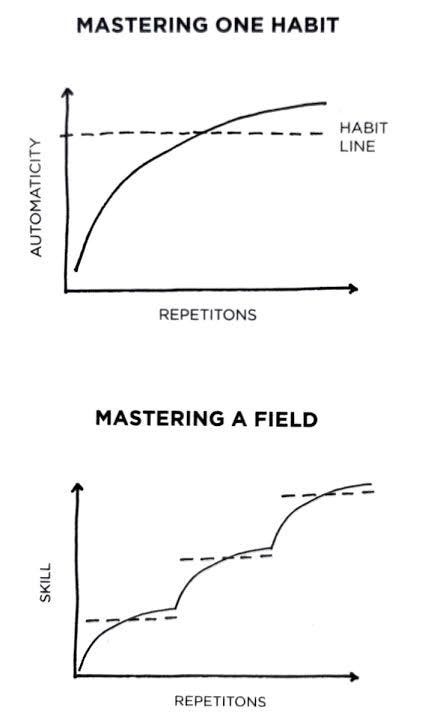
Review & reflection
Reflection and review is also the ideal time to revisit your identity. In the beginning, repeating a habit is essential to build up evidence of your desired identity. As you latch on to that new identity, however, those same beliefs can hold you back from the next level of growth. The tighter we cling to an identity, the harder it becomes to grow beyond it. Avoid making any single aspect of your identity an overwhelming portion of who you are.
Deliberate practice has a few key elements:
Decide on your metrics.
Measure your metrics.
Review your findings.
It’s simple but it’s easy to forget.
Improvement is not just about learning habits, it’s also about fine-tuning them. Some people want their reviews to be so complete that they keep a decision journal.
Identity
Repeating a habit is essential to build up evidence of your desired identity. The problem is that your new identity might conflict with your old identity (or aspects of it). Advice: make your identity fluid. Each habit unlocks the next level of your performance". Once a skill is mastered, there can be a decline in performance over time. So creating systems and habits should be like an endless process of learning and growing.
Conclusion
An atomic habit is a regular practice or routine that is not only small and easy to do but is also the source of incredible power; a component of the system of compound growth. Bad habits repeat themselves again and again not because you don’t want to change, but because you have the wrong system for change. Changes that seem small and unimportant at first will compound into remarkable results if you’re willing to stick with them for years. Atomic Habits from James Clear is the most comprehensive guide on how to change your habits and get 1% better every day to achieve goals. The purpose of setting goals is to win the game. The purpose of building systems is to continue playing the game. True long-term thinking is goal-less thinking. It’s not about any single accomplishment. It is about the cycle of endless refinement and continuous improvement.
Wowwww!!! Such a insightful, thoughtful and detailed summary, so beautifully written. First of all, love the way each and every chapter is broken down into sections, going deep into every idea mentioned in the book! Moreover, the ideas are presented in such a articulated fashion. Each point is broken down, dumbed-down making it so easy to understand the otherwise few complex areas of the book. I have read the book a year ago, and oh i wishhh i had this summary before reading the book, while reading it, and soon after reading it 🥹🥹🥹
The in-depth fashion of this summary really caught my eye. Please keep them coming, Im so excited for the upcoming summaries. Im a avid reason, but God, to be very honest, i could even skip reading the book by just reading the summary because its so good and detailed.
I’d really love for more and more summaries to come!! These would be such a good companion to my reading journey 🥹🥹🥹 all before, after and during reading the book.
As this is the first summary in this publication, Really appreciate the hard work that went behind drafting this. Its NOT AT ALL EASY! Alll the best for the future summaries 🥹🥹🥹 We all support your work!!